By Teresa Caruso · Updated October 30, 2026
The best food processor saves you real time on the jobs that wear you down by hand: chopping onions, shredding a block of cheese, slicing a pile of potatoes, or kneading pizza dough. The hard part is choosing one, because bowl sizes, motors, and attachments vary a lot between models.
We narrowed the field to five machines that cover every budget and kitchen size, from a compact 7-cup model to a 14-cup workhorse that home cooks have trusted for decades.
How We Researched
We compared specs, included attachments, warranties, and thousands of verified Amazon owner reviews for the most-recommended food processors of 2026. We also cross-checked the picks that expert testers at major kitchen publications return to again and again, then grouped them by the type of cook each one suits best.
The 5 Best Food Processors of 2026
1. Cuisinart 14-Cup Food Processor (DFP-14BCNY) – Best Overall
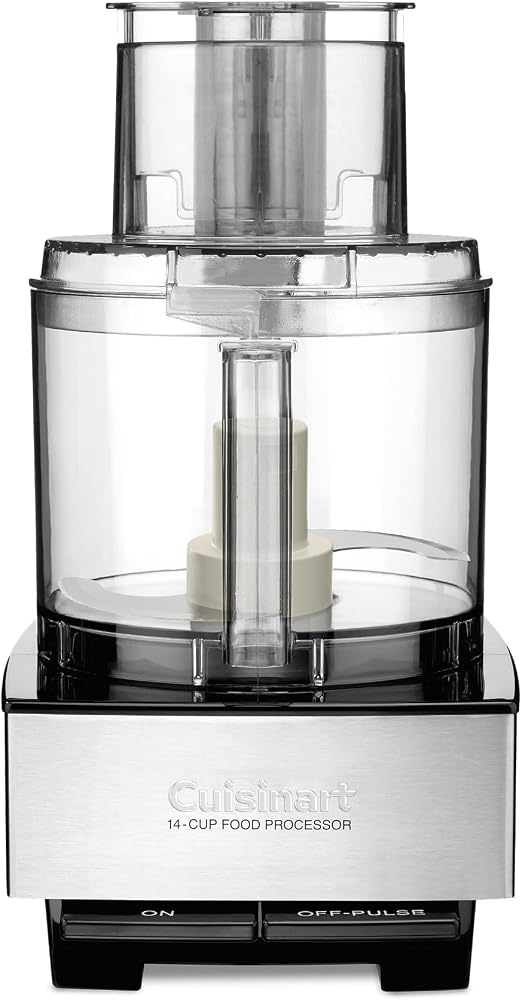
If you only buy one machine, this is the one we would point you to. The Cuisinart 14-cup pairs a 720-watt motor with a big work bowl, so it handles family-size batches of salsa, coleslaw, hummus, and bread dough without needing to work in rounds.
The design is refreshingly simple: two paddle controls (On and Off/Pulse) and an extra-large feed tube that takes whole vegetables. It ships with a 4mm stainless slicing disc, a medium shredding disc, and a chopping/mixing blade, and all of them are dishwasher-safe.
The trade-off is flexibility. The slicing and shredding discs are not adjustable, so you get one thickness unless you buy extra discs. Still, with a 4.5-star rating from more than 15,000 Amazon reviewers and a full 5-year motor warranty, it has earned its reputation as the classic workhorse.
- Large 14-cup bowl for family batches
- Powerful 720-watt motor handles dough
- Very simple two-button operation
- 5-year motor warranty
- Slicing and shredding discs are not adjustable
- Only one fixed slicing thickness out of the box
- Takes up a lot of counter space
2. Breville Sous Chef 9 (BFP610) – Best Premium
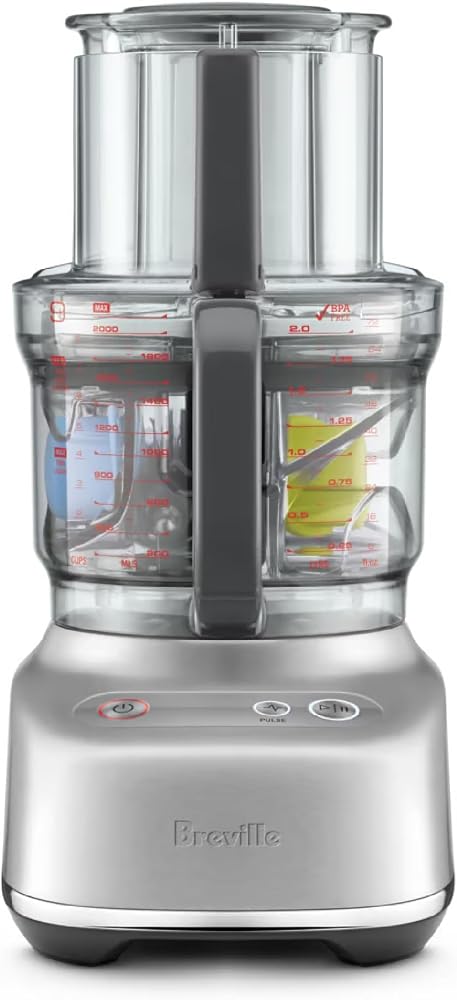
Breville’s Sous Chef line is the favorite of many serious home cooks, and the 9-cup BFP610 brings that precision to a more compact footprint. Its headline feature is the accessory set: a dicing kit, S-blade, reversible coarse/fine shredder, dough blade, and an adjustable slicer with 15 thickness levels.
Everything lives in a color-coded onboard storage caddy that fits inside the bowl, so you are not digging through a drawer for the right disc. The 2-in-1 feed chute is 4.7 inches wide, and the brushless induction motor is backed by a 30-year motor warranty (plus a 2-year product warranty).
It costs more than the other picks on this list, and the 9-cup bowl is smaller than the Cuisinart’s. But if you care about uniform cuts and want dicing built in, it is the most capable machine here, with a 4.7-star average on Amazon.
- Dicing kit included
- Adjustable slicer with 15 thickness settings
- Onboard storage caddy keeps blades organized
- 30-year motor warranty
- Premium price
- 9-cup bowl is smaller than full-size rivals
- Fewer Amazon reviews than older models
3. Ninja Professional Plus (BN601) – Best Value
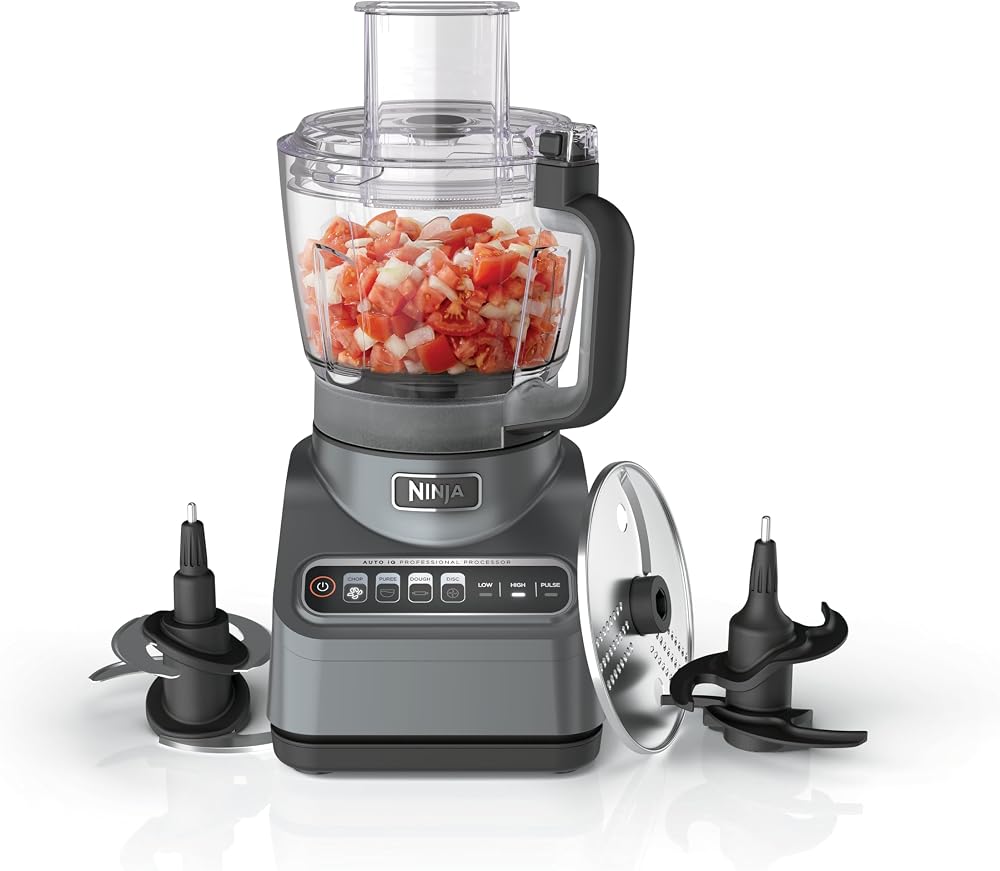
The Ninja BN601 gives you a lot of machine for the money. It runs on a 1000-peak-watt motor and has four Auto-iQ preset programs for chopping, slicing, pureeing, and dough, so you can press one button and walk away while it pulses for you.
The 9-cup bowl is big enough for weekly meal prep, and a dedicated dough blade is included for pizza and bread. All removable parts are BPA-free and dishwasher-safe, which keeps cleanup quick.
It is one of the most-reviewed food processors on Amazon (4.6 stars from more than 14,000 ratings). The plastic build does not feel as premium as Cuisinart or Breville, but for everyday chopping and dough it is hard to beat at its price.
- 1000-peak-watt motor
- 4 one-touch Auto-iQ presets
- Dough blade included
- Dishwasher-safe, BPA-free parts
- Mostly plastic construction
- Fewer slicing options than premium models
- Can be loud at full power
4. Hamilton Beach Stack & Snap 14-Cup – Best Budget Large-Batch
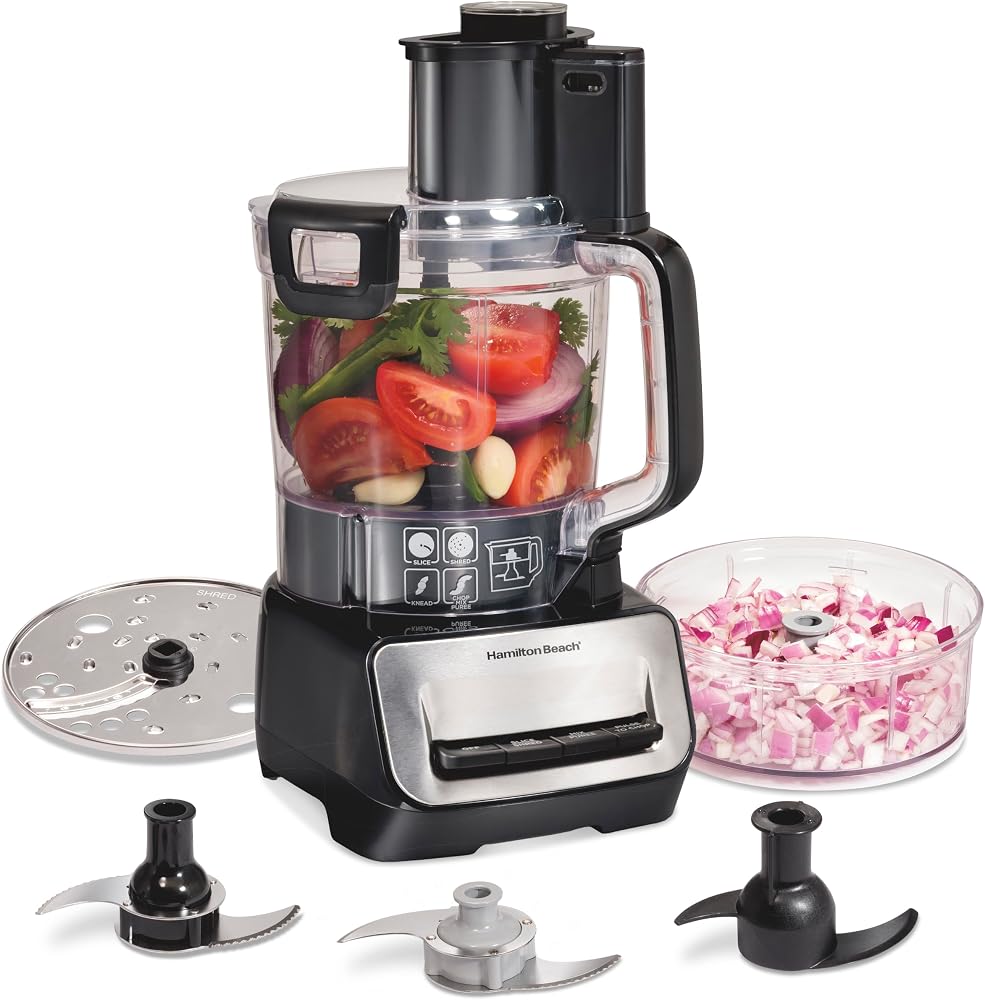
Want a big bowl without a big price? The Hamilton Beach Stack & Snap includes two bowls: a 14-cup bowl for large batches and a 4-cup mini bowl for small jobs like garlic or a single batch of pesto.
The Stack & Snap design removes the twist-and-lock struggle that frustrates many first-time owners, and a simple function guide on the front tells you which blade and button to use. It comes with four attachments: a reversible slicing/shredding disc, two chopping blades (one for each bowl), and a dough blade.
The 500-watt motor is the weakest on this list, so dense dough is not its strong point. But for chopping, slicing, and shredding on a budget, the two-bowl setup is genuinely useful.
- Two bowls: 14-cup plus 4-cup mini
- Easy Stack and Snap assembly
- Four attachments including a dough blade
- All removable parts dishwasher-safe
- 500-watt motor is the least powerful here
- Only a 1-year limited warranty
- Lighter build than premium brands
5. KitchenAid 7-Cup Food Processor (KFP0718) – Best for Small Kitchens
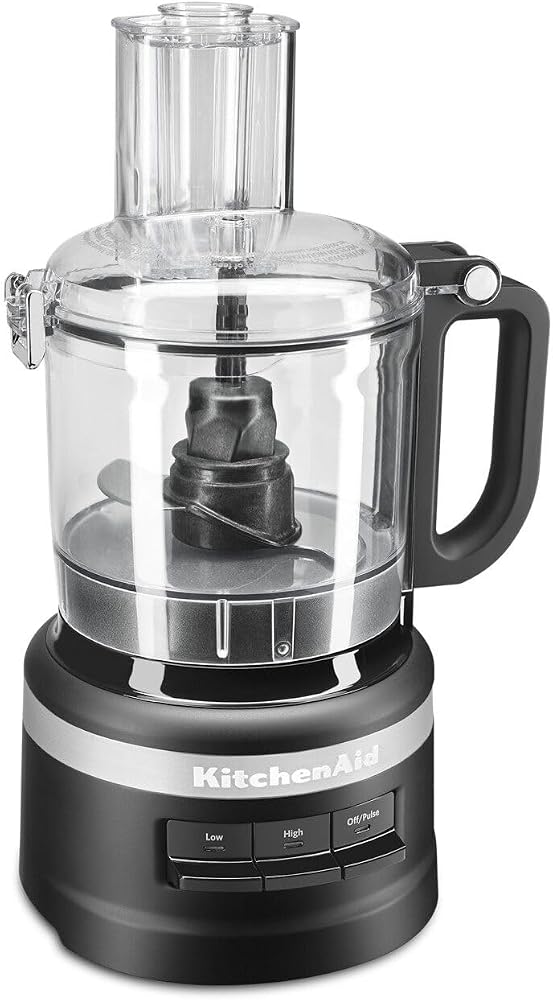
For apartments and small households, the KitchenAid 7-cup is the sweet spot. Its biggest strength is storage: every blade and disc fits inside the work bowl, so the whole machine takes up one small spot in a cabinet.
Assembly is twist-free with a one-click bowl and latched lid, and the 2-in-1 feed tube handles both whole tomatoes and thin items like carrots. You get three speeds (High, Low, and Pulse) on easy-press paddles, plus a multi-purpose blade and a reversible slicing/shredding disc.
The 7-cup bowl is too small for big-batch cooking, and there is no dough blade. For a household of one to three people, though, it is a tidy, reliable machine with a 4.5-star rating from nearly 8,000 Amazon reviewers.
- Compact, with all parts stored in the bowl
- Twist-free one-click assembly
- Three speeds including Pulse
- Leak-resistant bowl is easy to rinse
- 7-cup bowl limits batch size
- No dough blade included
- Only one slicing/shredding disc
Best Food Processor Comparison Table
| Model | Bowl Size | Motor | Dough Blade | Motor Warranty | Best For |
|---|---|---|---|---|---|
| Cuisinart DFP-14BCNY | 14 cups | 720 W | Chopping/mixing blade | 5 years | Families, big batches |
| Breville Sous Chef 9 BFP610 | 9 cups | Brushless induction | Yes | 30 years | Precision cuts, dicing |
| Ninja BN601 | 9 cups | 1000 peak W | Yes | See manufacturer | Value, one-touch presets |
| Hamilton Beach Stack & Snap | 14 cups + 4-cup mini | 500 W | Yes | 1-year limited (unit) | Big bowl on a budget |
| KitchenAid KFP0718 | 7 cups | 3 speeds | No | See manufacturer | Small kitchens |
How to Choose the Best Food Processor for Your Kitchen
Bowl capacity. A 7- to 9-cup bowl suits one to three people. Families and meal-preppers should look at 11 to 14 cups. If you often make small amounts too, a model with a mini bowl (like the Hamilton Beach) saves you from scraping a tablespoon of garlic out of a giant bowl.
Motor power. Wattage matters most for dough and dense nut butters. Around 700 watts and up handles bread dough comfortably; lower-wattage models are fine for chopping and slicing.
Discs and blades. Check what is in the box. An adjustable slicer (like Breville’s) gives you control over thickness, while fixed discs mean buying extras later. A dough blade is worth having if you bake.
Feed tube size. A wide feed tube lets you drop in whole potatoes or blocks of cheese, which cuts down on pre-chopping.
Assembly, storage, and cleanup. Twist-lock bowls frustrate many owners, so stack-and-snap or one-click designs are a real upgrade. Dishwasher-safe parts and onboard blade storage make a food processor something you actually use instead of something stuck in the back of a cabinet. Wash blades and bowls promptly after raw meat; the FoodSafety.gov 4 steps to food safety are a good reference.
If you have already settled on a brand, see our deeper guides to the best Cuisinart food processor and the best KitchenAid food processor.
Food Processor vs Blender: Do You Need Both?
The two look similar but do different jobs. A blender has a tall jar and fast fixed blades that pull ingredients into a vortex, which is ideal for smoothies, frozen drinks, and silky soups. A food processor has a wide, flat bowl, slower S-blade action, and interchangeable discs.
That design lets a food processor slice, shred, grate, and knead dough, which a blender cannot do. It also handles thick mixtures like hummus, pesto, and nut butter without needing extra liquid.
A food processor can stand in for a blender on thick purees and dips, but it will not give you a smooth, pourable texture, and a wide bowl can leak with thin liquids. If you mostly drink smoothies, a blender is enough. If you cook from scratch and do a lot of chopping or shredding, the food processor earns its space.
Pros and Cons of Owning a Food Processor
Pros:
- Cuts prep time for chopping, slicing, and shredding.
- Gives consistent cuts, which helps food cook evenly.
- Kneads dough and makes dips, sauces, and nut butters.
- Shreds cheese and vegetables for a fraction of pre-shredded prices.
Cons:
- Full-size models are bulky and heavy to pull out of cabinets.
- More parts to wash than a knife and cutting board for small jobs.
- Blades are very sharp and need careful handling.
- Not ideal for thin liquids or very small quantities.
Common Mistakes to Avoid
- Overfilling the bowl. Stay under the max-fill line, especially with liquids, or the lid can leak.
- Running instead of pulsing. For chopped onions or salsa, short pulses give even pieces. Holding the button turns them to mush.
- Pushing too hard on the feed tube. Let the disc do the work; heavy pressure gives uneven slices.
- Processing hot liquids. Let soups cool slightly first, and work in smaller batches.
- Buying the wrong size. A 14-cup bowl is overkill for small jobs, and a 7-cup bowl is frustrating for a family. Match the bowl to how you cook.
How We Researched the Best Food Processors
We started with the models most often recommended in 2026 by kitchen testing publications and Google’s top results, then kept only those sold on Amazon US. For each one we reviewed the manufacturer’s specs, included accessories, warranty terms, and the rating and volume of verified Amazon reviews. We did not test these units in our own kitchen; our picks are based on that research and long-term owner feedback.
FAQ
Not always. If you mainly make smoothies, soups, and sauces, a blender covers you. If you regularly chop vegetables, shred cheese, slice produce, or make dough, a food processor does those jobs faster and better than a blender.
For thick mixtures, yes. A food processor works well for purees, hummus, pesto, and dips. It will not create the smooth, pourable texture a blender gives, and thin liquids can leak from the wide bowl.
Full-size models are bulky and take up counter or cabinet space, there are several parts and sharp blades to wash, and they are less efficient for very small amounts or thin liquids.
A food processor can slice, shred, and grate with interchangeable discs, knead bread and pizza dough with a dough blade, and chop vegetables into even pieces without turning them to liquid.
A 7- to 9-cup model suits singles, couples, and small kitchens. Families and frequent meal-preppers are better served by an 11- to 14-cup bowl. A mini bowl insert is handy if you also make small batches.
They suit different cooks. The Breville Sous Chef 9 offers more precision, with a dicing kit and an adjustable slicer, plus a longer motor warranty. The Cuisinart 14-cup is simpler, has a larger bowl, and has a long track record as a dependable workhorse.
The Bottom Line
For most kitchens, the Cuisinart 14-Cup is the best food processor: a large bowl, a sturdy 720-watt motor, and a design that has stayed reliable for years. Choose the Breville Sous Chef 9 if you want built-in dicing and adjustable slicing, the Ninja BN601 for the best value, the Hamilton Beach Stack & Snap for a big bowl on a budget, or the KitchenAid 7-Cup if space is tight.
Check Price on Amazon